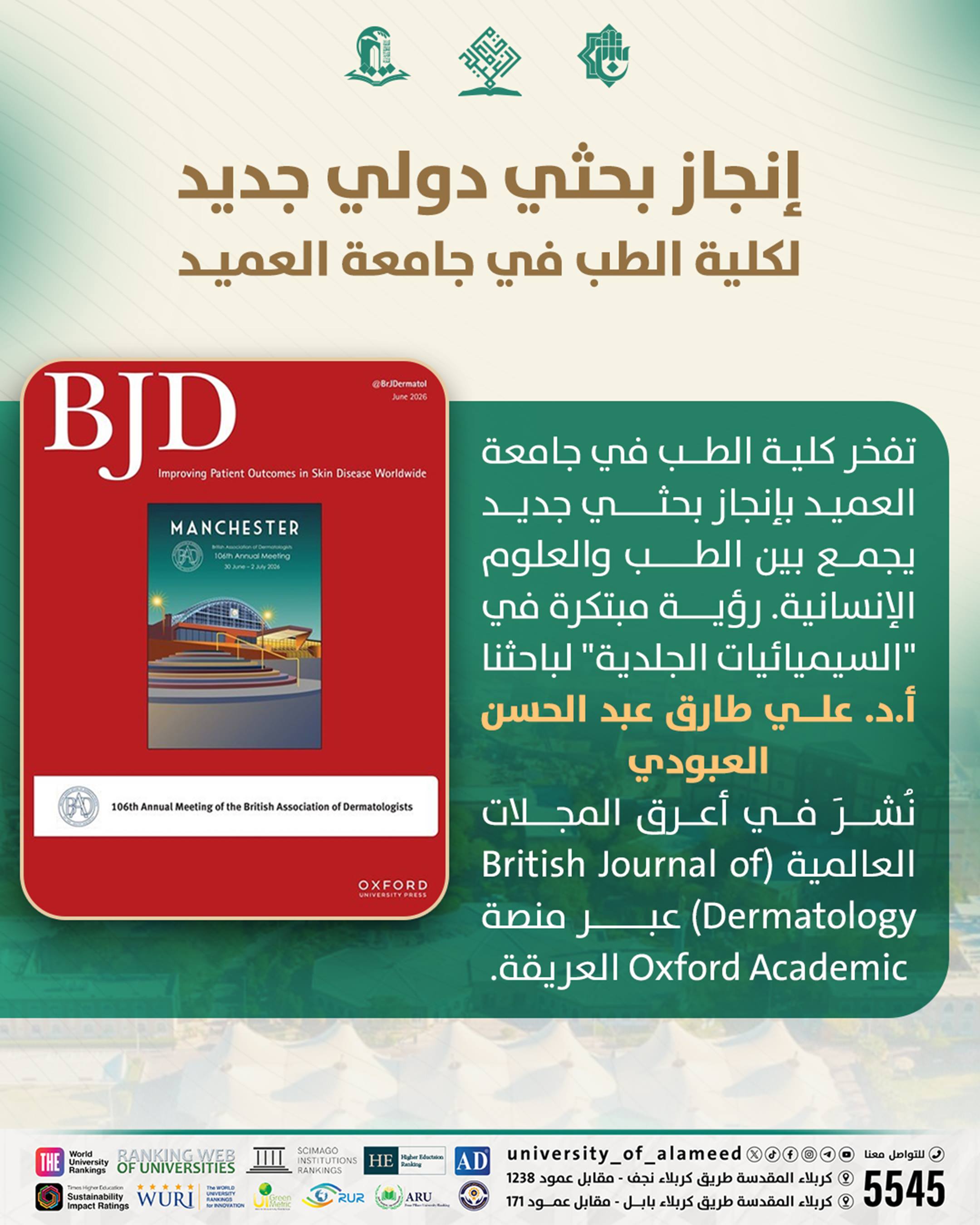
In a new scientific achievement reflecting the growing presence of Iraqi academic research in international scientific forums, a faculty member at the College of Medicine at our university, Prof. Dr. Ali Tariq Abdul-Hassan Al-Abboudi, contributed a scientific study entitled "PS45 Dermatossemiotics: moving towards person-centred care in psychodermatology," published in the British Journal of Dermatology, Volume (195), Supplement (1), on June 26, 2026, via the Oxford Academic platform of Oxford University Press (DOI: 10.1093/bjd/ljag086.660).
The research presents a novel theoretical framework in the field of dermatosemiotics, reconsidering the relationship between the skin, the human being, psychological experience, and meaning—transcending the reductionist view that treats skin disease as a biological phenomenon detached from the patient's human context.
This vision is based on regarding the skin not merely as a biological organ, but as a bearer of meaning and a sign where physical, psychological, social, and existential dimensions intersect. Dermatosemiotics proposes interpreting skin disease within a web of signs, significations, and lived experiences of the patient.
This approach seeks to transition from viewing the disease as a pathological entity detached from the individual to a person-centred care model, in which the patient's lived experience becomes an essential component of clinical and therapeutic understanding.
According to this perspective, a dermatological condition is not merely a diagnosis; rather, it can be read as a human text open to interpretation, formed by bodily signs, personal narrative, psychological experiences, relationships, and the sociocultural context within a network of overlapping texts and signs, opening the horizon to the concept of disease as text and intertextuality.
This proposition intersects with modern trends in health research that focus on the patient's lifeworld and lived experience, seeking to understand the meaning that the illness experience confers upon human life rather than reducing it solely to a medical diagnosis. The significance of the research lies in its endeavor to build an epistemic bridge between medical and human sciences by integrating dermatology, psychodermatology, psychology, semiotics, hermeneutics, and phenomenology, thereby enabling an understanding of disease as both a medical and a human phenomenon simultaneously.
Furthermore, this approach aligns with the growing global trend toward interdisciplinary and transdisciplinary research, which transcends traditional disciplinary boundaries to produce knowledge that is more integrated and relevant to the human experience.
The study poses a question that goes beyond the boundaries of conventional diagnosis: What does skin disease mean to the person living it? Through this inquiry, the dermatological sign transforms from a mere observable and measurable phenomenon into one that can be understood and interpreted within the patient's world and lived experience, thereby advancing the concept of human-centered healthcare.
This proposition represents a step toward establishing a new theoretical vision in psychodermatology that bridges body and meaning, illness and experience, sign and interpretation, and medicine and the humanities, thereby reinforcing the presence of Iraqi scientific research in cutting-edge interdisciplinary and transdisciplinary research pathways.